THE ICON VERSUS ARTIFICIAL INTELLIGENCE

Views: 51

St. Thomas Aquinas says an image should have three simultaneous qualities:

1. Likeness to the prototype.

2. Derivation from it.

3. Similarity of species with it.

Artificial Intelligence (AI) has proficiency for generating likeness of a subject different than photography. Using unprecedented computational speed and power, AI can excel in generating a likeness from prior data using a method void of human intuition. Chopping up data into meaningless tiny pieces and reconstructing an image under the constraint of a set of parameters can even be thought of as insane and terribly inefficient by humans. But AI gets away with it with sheer computational power and speed. Almost reminds one of the destruction/reconstruction cycle of revolutions and usury-based economies. And one can wonder, in this same vein, what the results will be, and how much dilution of likeness occurs, as it uses prior AI images to generate new ones. One could even say that likeness to the prototype is not even a goal, since unlike photography, the prototype has to be destroyed as part of the process.

But holy art is more than about an image. They require a pious human artist to get a more faithful likeness to prototype since the prototype has a spiritual nature that needs to come through. Compositio loci is a foundational Ignatian prayer technique that involves mentally constructing the setting of a biblical scene, character, or spiritual mystery to facilitate imaginative contemplation. With this, holy art can result and be “derived from the prototype” hopefully with the original immaterial features. Perhaps the best example of this being used in art is how St. Francis permanently changed the Christmas experience by popularizing the manger scene. The Ignatian practice aims to transform prayer into a childlike, imaginative encounter with the divine event. The artist submits to finding God in the present to direct their work spirited by God’s story. This is a key of St. Ignatius’ Spiritual Exercises, designed to help individuals discern God’s will by embedding themselves in sensory-rich meditation. Used for art, a holy method becomes a means to introduce a holy moment for the pious viewer or inspire piety into the non-pious. We can see here how there is also a form of similarity of species, where holiness from the source event, is hopefully transferred to the artist, and potentially to the observer.

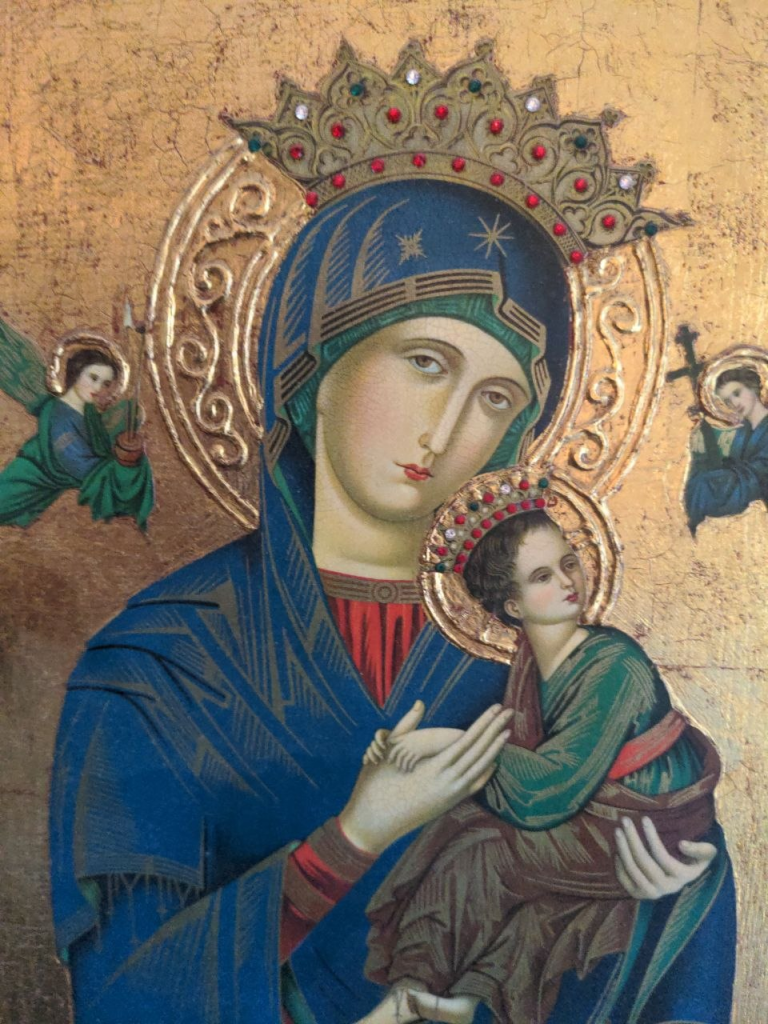
Icons are yet more than holy art. What if the imagination of the artist and observer are not required? What if even the skills of the iconographer are not needed or secondary? In the apostolic traditions there is a theme of the Icon “Not Made by Hands” (feast day August 16 in the Eastern Calendar). In the western tradition there is Our Lady of Guadalupe. We don’t even need to call the image of Our lady of Guadalupe an image. We simple say Our Lady of Guadalupe to refer to the image. Here the likeness IS the prototype and the derivation IS divine and not just from the divine. We are SEEING the species independent of our imagination or belief. There are many other examples. Some holy icons like Our Mother of Perpetual Help have been attributed to St. Luke. Critical thinkers refute this possibility since the icon is believed to have been painted in the 13 Century. But why could not St. Luke have been the iconographer/intercessor in the 13th Century any more than St. Anthony of Padua can find your lost keys today?

In Colossians 1:15, the Apostle Paul writes, “He [Christ] is the icon of the invisible God, the firstborn over all creation.” The Greek word for icon is eikōn, which means an exact representation. Not just a LIKENESS TO THE PROTOTYPE. We know that Christ is identical to God the Father. He is of the same Divine SPECIES except for being eternal begotten (DERIVED) of the Father. Christ is the incarnation of the invisible God, who disallowed heavenly images until this Incarnation. The immaterial becomes material. The source of grace for mankind. As part of the incarnation, icons become as St. John of Damascus says “a channel of divine grace” for mankind.
The Dual Nature of Christ and What It Means To Us. Guadalupe Revisited.

Views: 96

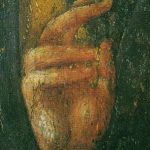
Jesus Christ is God and and Man, the staple teaching about God in His Church. This has been true since the birth of Christ, actually since the Annunciation, when Christ was conceived by God the Holy Spirit in the womb of Mary. Perfectly God. Perfectly Man. Two natures. One Person. This dual nature (hypostasis) has been expressed in the Oral Apostolic tradition and in iconography, long before the printing press and the more widespread literacy that occurred in the second millennium. In ancient iconography, this is written in the extension of the second and third digit of the right hand of Christ as in the ancient icon of Christ Pantocrator from Mount Sinai monastery:

(The opposing two remaining fingers with the thumb represent the Triune God, Father, Son and Holy Spirit in one Divine Person, but that is not the subject of this essay.)

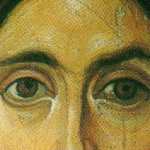
The dual nature is also written in the asymmetry of the eyes and facial expression. The asymmetric eyes indicate Christ’s (God’s) new (since the Incarnation) will to see with both Heavenly and human eyes.

A Heavenly and earthly perspective. This is for us, as He intercedes for us humans before God the Father. It is also representative of His life when He walked on earth, Perfectly God, and perfectly human. Two planes of existence. (Here are two examples of Christ being perfectly human in humility while being God: John 11:33-35, Matthew 24:35-37.)

Now what this means to us in the Vine of Christ is exactly the same. It is our life on two planes of existence, the human plane and Divine plane, where the Divine is through the Sacraments, the perspective of the eastern churches. How we live in the Divine plane is by living our ordinary human lives while partaking in the Sacraments. (Willful rejection of the Divine plane of existence is remedied through the Sacrament of Confession). We cannot fathom the full significance of our Divine plane of existence at this time (we can barely appreciate the significance of our human existence) but one way we can remind ourselves of this mystery is to think of ourselves as a chamber or temple where God and His angels, patriarchs, faithful, saints and the Queen of saints meet, confer, inspire, and act exactly in our moment in history, without us necessarily knowing of any plan or action, nor necessarily while receiving any inspiration, although He may let us, His vessels, know some things according to His Holy will or even give us a supernatural power to execute His will. Sometimes this occurs in the humiliations and sufferings of our human lives and these states may be when His power is most manifest (2 Corinthians 12:9). Here in the human plane, we work out God’s justice in penance. The Sacraments are the exquisite methods used by God whereby He imparts His Nature to us in doses while implementing His will on earth, even before we are fully converted. Thy kingdom come, on earth as it is in heaven.

“For as the bread, which is produced from the earth, when it receives the invocation of God, is no longer common bread, but the Eucharist, consisting of two realities, earthly and heavenly; so also our bodies, when they receive the Eucharist, are no longer corruptible, having the the hope of the resurrection to eternity.”

Saint Irenaios of Lyon, Against Heresies, Book 4, Chapter 18, 2nd Century

How encouraging it should be to seek the Sacraments in this, God’s plan of salvation. How encouraging it should be to know that Christ’s dual nature becomes manifest in us this way. But how ineffable is our understanding a mystery so great. So let’s look at another icon for inspiration. This time of the Mother of God and from a different era and civilization, also without widespread literacy.

The asymmetry of the face of the Virgin of Guadalupe has been brought up recently with insight.

This link exposes the two sides of the Virgin’s face. We can extend this further, noting that the “brighter” or blissful side of the face is on the heavenly side, represented by the mantle of stars and the “sad”, or we can say more human/suffering side, with the tear drop in the eye, is on the side of the earth colored tapestry.  The pattern on the earthly tapestry is a direct reminder of the Mayan calendar for the peoples of that culture and represents our human existence at any moment in history. This is the sojourning (or revealing/manifesting?) side with the knee bent forward. (Click on image for detail.)

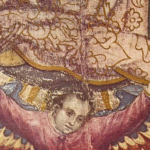
The Virgin’s forearm lifts the heavenly garment out of the way to expose the earthly tapestry for us on that side of her face. The winged creature reinforces this point by having one hand on the heavenly and the other on the earthly vestment, bringing each forward to parallel the facial expressions. And if you look closely at his face, you can wonder of another creature with human and heavenly perspective.

How ineffable is our understanding a mystery so great, but how full of grace is the Theotokos, assumed into heaven body and soul, to give us insight into the mystery in such a beautiful way.

Holy Virgin in my heart
every day before I start.
And when the daily heartbeats stop,
catch me Virgin when I drop.