Views: 134
St. Thomas Aquinas says an image should have three simultaneous qualities:
1. Likeness to the prototype.
2. Derivation from it.
3. Similarity of species with it.
Artificial Intelligence (AI) has proficiency for generating likeness of a subject different than photography. Using unprecedented computational speed and power, AI can excel in generating a likeness from prior data using a method void of human intuition. Chopping up data into meaningless tiny pieces and reconstructing an image under the constraint of a set of parameters can even be thought of as insane and terribly inefficient by humans. But AI gets away with it with sheer computational power and speed. Almost reminds one of the destruction/reconstruction cycle of revolutions and usury-based economies. And one can wonder, in this same vein, what the results will be, and how much dilution of likeness occurs, as it uses prior AI images to generate new ones. One could even say that likeness to the prototype is not even a goal, since unlike photography, the prototype has to be destroyed as part of the process.
But holy art is more than about an image. They require a pious human artist to get a more faithful likeness to prototype since the prototype has a spiritual nature that needs to come through. Compositio loci is a foundational Ignatian prayer technique that involves mentally constructing the setting of a biblical scene, character, or spiritual mystery to facilitate imaginative contemplation. With this, holy art can result and be “derived from the prototype” hopefully with the original immaterial features. Perhaps the best example of this being used in art is how St. Francis permanently changed the Christmas experience by popularizing the manger scene. The Ignatian practice aims to transform prayer into a childlike, imaginative encounter with the divine event. The artist submits to finding God in the present to direct their work spirited by God’s story. This is a key of St. Ignatius’ Spiritual Exercises, designed to help individuals discern God’s will by embedding themselves in sensory-rich meditation. Used for art, a holy method becomes a means to introduce a holy moment for the pious viewer or inspire piety into the non-pious. We can see here how there is also a form of similarity of species, where holiness from the source event, is hopefully transferred to the artist, and potentially to the observer.
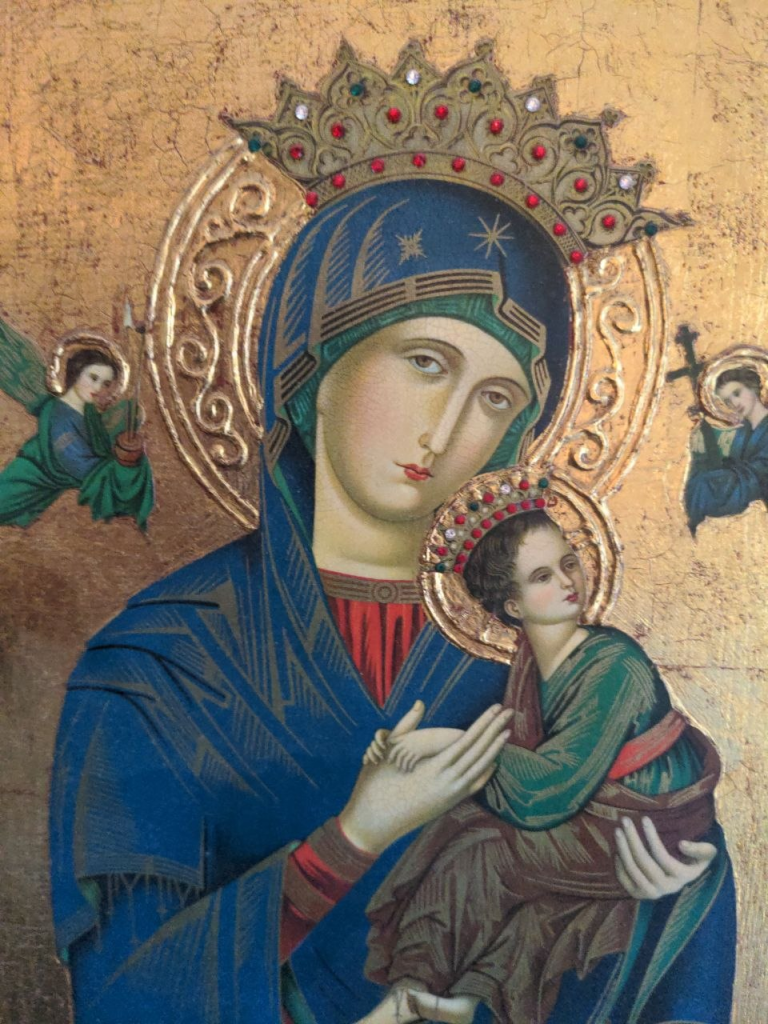
Icons are yet more than holy art. What if the imagination of the artist and observer are not required? What if even the skills of the iconographer are not needed or secondary? In the apostolic traditions there is a theme of the Icon “Not Made by Hands” (feast day August 16 in the Eastern Calendar). In the western tradition there is Our Lady of Guadalupe. We don’t even need to call the image of Our lady of Guadalupe an image. We simple say Our Lady of Guadalupe to refer to the image. Here the likeness IS the prototype and the derivation IS divine and not just from the divine. We are SEEING the species independent of our imagination or belief. There are many other examples. Some holy icons like Our Mother of Perpetual Help have been attributed to St. Luke. Critical thinkers refute this possibility since the icon is believed to have been painted in the 13 Century. But why could not St. Luke have been the iconographer/intercessor in the 13th Century any more than St. Anthony of Padua can find your lost keys today?
In Colossians 1:15, the Apostle Paul writes, “He [Christ] is the icon of the invisible God, the firstborn over all creation.” The Greek word for icon is eikōn, which means an exact representation. Not just a LIKENESS TO THE PROTOTYPE. We know that Christ is identical to God the Father. He is of the same Divine SPECIES except for being eternal begotten (DERIVED) of the Father. Christ is the incarnation of the invisible God, who disallowed heavenly images until this Incarnation. The immaterial becomes material. The source of grace for mankind. As part of the incarnation, icons become as St. John of Damascus says “a channel of divine grace” for mankind.